
The Yankees wrapped up business with their fifth-round pick fast, and they didn't try to save a dime doing it. Texas A&M catcher Bear Harrison signed for $437,200 — full slot value for pick 160 — putting a bow on a draft class the Yankees clearly didn't want to nickel-and-dime.
5th-rder Bear Harrison signs w/@Yankees for $437,200 (full slot 160 value). @AggieBaseball C, hit .294/.493/.608 with 11 HR as junior, OBP skills & righty pop. Brother of Kyle. @MLBDraft
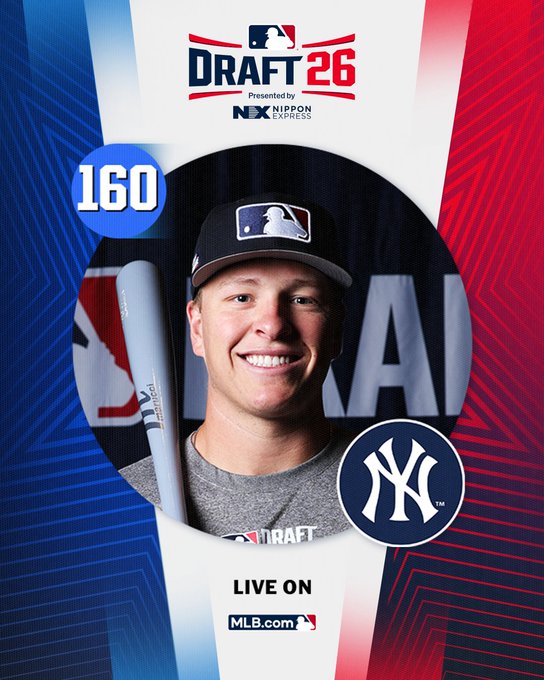
Full slot deals aren't a given in the 5th round. Teams love to shave a little off there to redirect bonus pool money to harder college seniors or upside prep bats they overpaid for elsewhere. Handing Harrison every dollar of slot is the Yankees signaling they see him as a legit piece, not a org-filler arm behind the plate.
The profile backs that up. Harrison hit .294/.493/.608 with 11 home runs as a junior for the Aggies, per Callis, the kind of OBP-plus-pop combo that gets scouts to squint twice at a college catcher. He's a converted transfer too — he started his career at St. Mary's before landing in Aggieland, and by the time draft day rolled around he'd climbed onto Baseball America's rankings as a legitimate late-round sleeper rather than a org-depth arm.
There's also a built-in storyline here: Bear is the brother of big-league pitcher Kyle Harrison, so the Yankees are betting on bloodlines as much as the bat. Whether he ends up catching regularly in the org or morphing into a bat-first utility piece, a righty-power catcher with real on-base skills is exactly the kind of lottery ticket a team wants sitting on full slot money in Round 5.
Now it's the unglamorous part — short-season ball, a swing that has to hold up against wood bats and better arms every night, and a defensive profile that has to prove itself against actual pro base-stealers. But the Yankees just told you where they think the ceiling is by paying every cent of slot for him.