
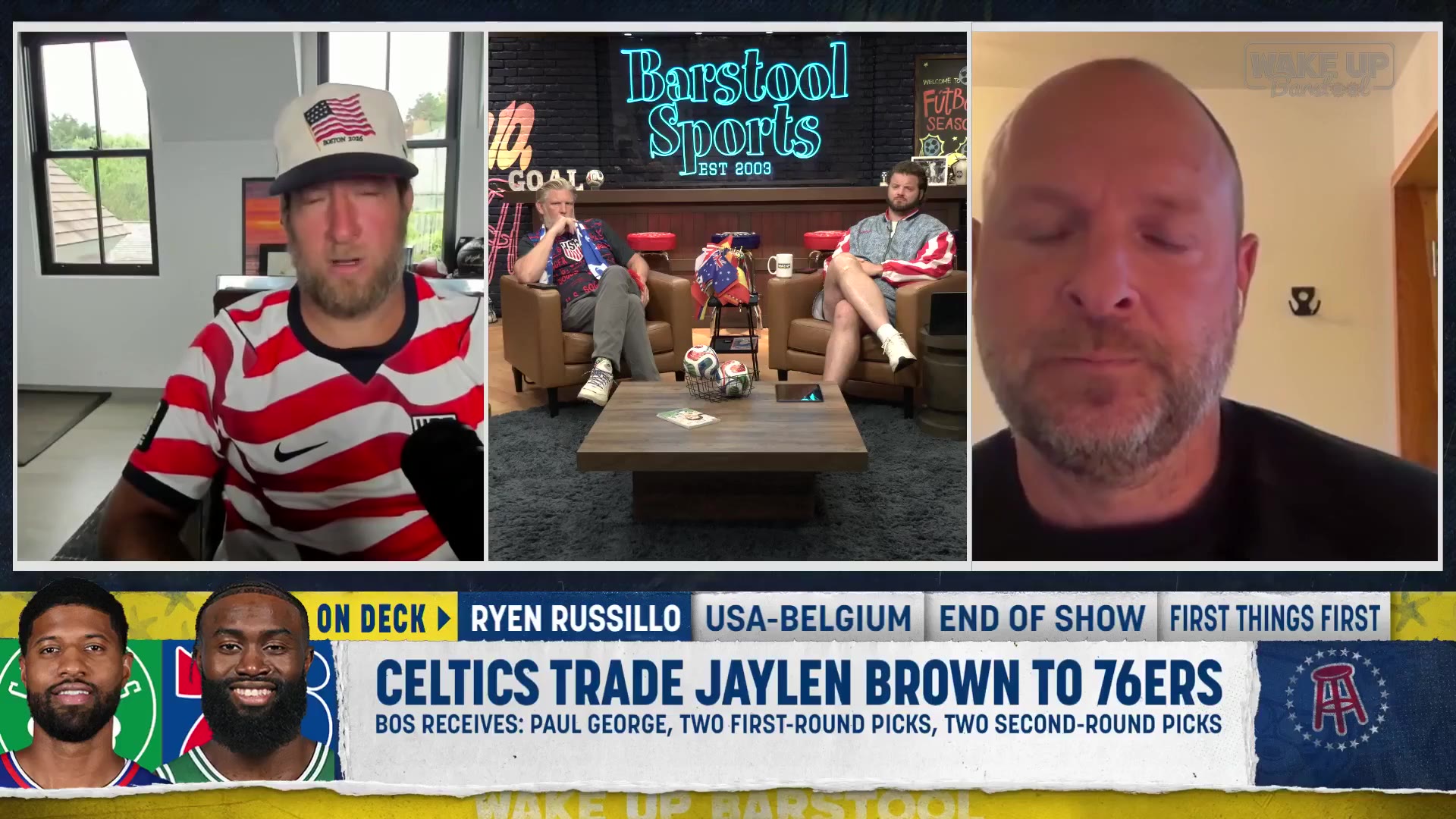
The trade itself is done. Boston sent Jaylen Brown to Philadelphia for Paul George and a stack of first- and second-round picks, ending a 10-year run that included five All-Star nods and a sixth-place MVP finish last season. But a done deal hasn't stopped basically every NBA media outlet from re-litigating it daily, and this week the conversation shifted from "did Boston really do this" to "was Boston right."
Ryen Russillo laid out the theory that's been floating since the deal broke: this doesn't happen without Jayson Tatum's blessing.
That's the emotional angle. The financial angle is where things get uncomfortable for Brown's camp, and it's the angle Pardon My Take leaned into this week when Brian Windhorst came on to explain the front office's thinking.
Brian Windhorst broke down the front office logic on Pardon My Take: Boston believed it could spend the money more efficiently elsewhere.
Windhorst's reporting has been the throughline of this entire saga. He's said the Celtics' internal models valued Brown well below his $57 million salary, and that the front office actually viewed Derrick White as the team's best player last season, not Brown. That's the kind of thing that turns a trade into a referendum. It's not just "we needed size" or "we needed shooting" — it's the front office publicly, if quietly, saying the numbers said sell high on a guy who was one of the best players in franchise history.
Pardon My Take's latest episode dug into how analytics specifically tanked Brown's market around the league.
That episode is really the crux of the ongoing debate: analytics didn't just influence Boston's asking price, they reportedly cratered Brown's value across the whole league, which is why a former All-Star and Finals starter fetched what amounted to Paul George and picks rather than a superstar package. When a model says a $57 million player is producing like a $41 million one, other teams start negotiating from that number too, not from the resume.
Not everyone in Boston media is on board — Mike Mutnansky says he still trusts Brad Stevens, but he hates this particular swing.
That split is basically the whole discourse in miniature. Nobody's arguing Brad Stevens is bad at his job. The argument is whether leaning this hard into a valuation model, on a homegrown All-Star who helped deliver a title, is a defensible process even if it's directionally smart. Paul George brings size, shot creation and a track record, but he's also older and has an injury history that makes this swap a bet on health as much as fit. Boston is wagering that the picks and George's remaining prime outweigh whatever Brown still has left, and Philadelphia is betting the opposite. Neither side gets a real grade until these teams actually play out a full season with the new pieces — until then, this is going to stay a podcast staple, not a settled question.