
Everybody had a nice time at the All-Star Game. There was a Home Run Derby, some highlight-reel catches, the usual mid-summer vibes. But according to Jeff Passan, there was something else hanging over the whole week: the near-certainty that MLB owners are about to lock the players out the moment the current collective bargaining agreement expires.

A pall hung over the festivities of the All-Star Game this week. A lockout is coming -- and at the heart of it is a profound core-economics disagreement. Free at ESPN: The latest on labor, where it stands, where it's going and what you need to know: t.co/1qC8iyKb0X
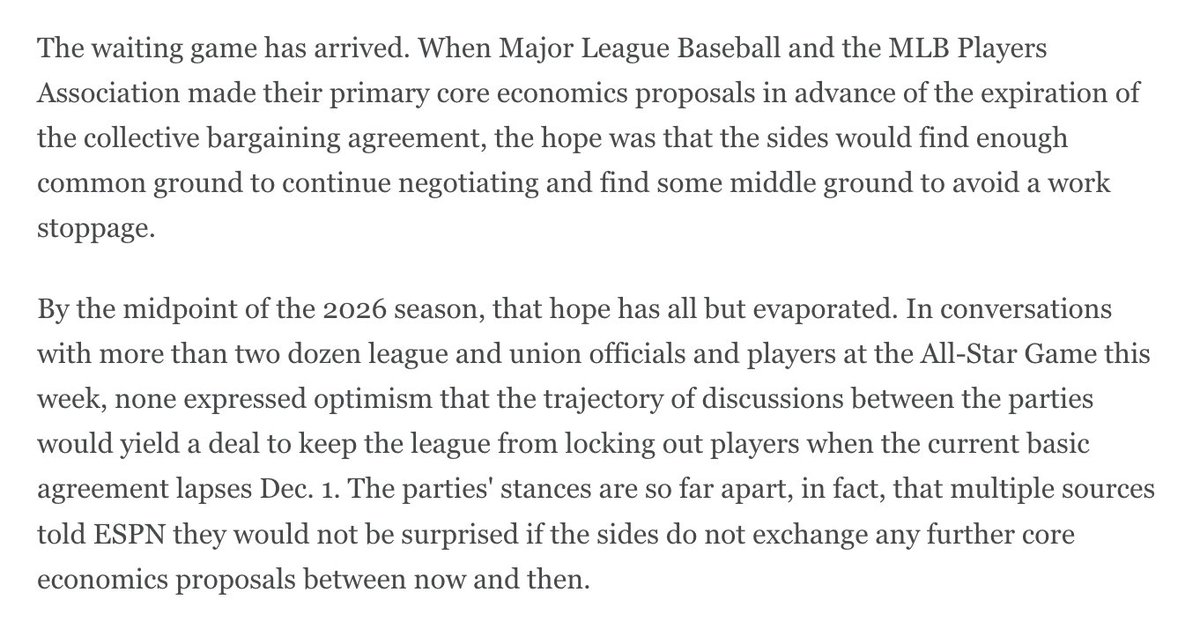
That expiration date is December 1, 2026, and it's not sneaking up on anyone. This isn't the normal song-and-dance where both sides haggle over a luxury tax number and eventually shake hands. Passan's reporting frames this as a fight over the actual system baseball has operated under for decades -- MLB wants to introduce a salary cap for the first time in more than 30 years, and the union is not interested in discussing it.
The numbers being floated are jarring for a sport with no cap history: a hard ceiling around $245.3 million and a hard floor around $171.2 million, meant to squeeze the gap between big spenders and bottom-feeders. Owners are selling it as competitive balance. The MLBPA is selling it as a pay cut in disguise, reportedly accusing the league of trying to claw back billions in player compensation while dressing it up as reform.
It doesn't help that this proposal is landing right after a winter full of nine-figure contracts got dropped into the discourse. Deals like the Dodgers' four-year, $240 million commitment to Kyle Tucker are exactly the kind of spending that reportedly has ownership ready to blow the whole system up, with one official going so far as to say owners are willing to burn the house down to get a cap, even if it costs part of the 2027 season.
Players see it the opposite way. Their argument is that the sport's actual competitive problem isn't teams spending too much, it's teams that refuse to spend at all, pocketing revenue-sharing money instead of fielding a roster that tries to win. A cap, in that view, punishes the Dodgers and Mets of the world for doing exactly what fans want, while letting the cheap ownership groups off easy.
None of this is background noise for a random offseason -- it's a threat to next season's entire operating calendar, from free agency to spring training to whatever betting markets are built around a 2027 slate that may or may not start on time. If there's no real movement by early March, the sport is genuinely staring down a delayed or shortened season, and this time it's not just a fight over money inside an agreed system. It's a fight over what kind of system baseball is going to be.