





SC judge denies NCAA eligibility bid for McDoom, Hill, Verhoff
TLDR: A South Carolina judge denied a group of former college football players' bid for a restraining order against the NCAA that would have opened a path back for the 2026 season, adding to a growing string of inconsistent state-by-state eligibility rulings after similar denials in Colorado, Nevada and New York.
The NCAA's age-based eligibility model has turned into a 50-state legal scramble, and South Carolina just became the latest state where the players lost. Judge Jessica Salvini denied a group of former college football players a temporary restraining order that would have opened a pathway back onto rosters ahead of the 2026 season, according to Pete Nakos.
A South Carolina judge has denied multiple former college football players a temporary restraining order against the NCAA that would have opened a pathway to a return ahead of the 2026 season. t.co/xiq73G8oKc

The suit named a handful of class-of-2022 recruits still trying to squeeze one more year out of college ball, including former Cincinnati cornerback Matthew McDoom, Wisconsin cornerback D'yoni Hill and North Carolina kicker Rece Verhoff. None of them have a South Carolina connection, and that turned out to be the problem. Salvini's ruling leaned on jurisdiction: she wasn't convinced a South Carolina court had any business granting relief to plaintiffs who never played for a South Carolina school or lived in the state.
That's a technical off-ramp, not a ruling on the merits, but it still counts as a win column entry for the NCAA. And it's piling up fast. As Ross Dellenger laid out, judges in Colorado, Nevada and New York have all denied similar requests for injunctions in the last stretch alone, while other athletes elsewhere have actually won their cases.
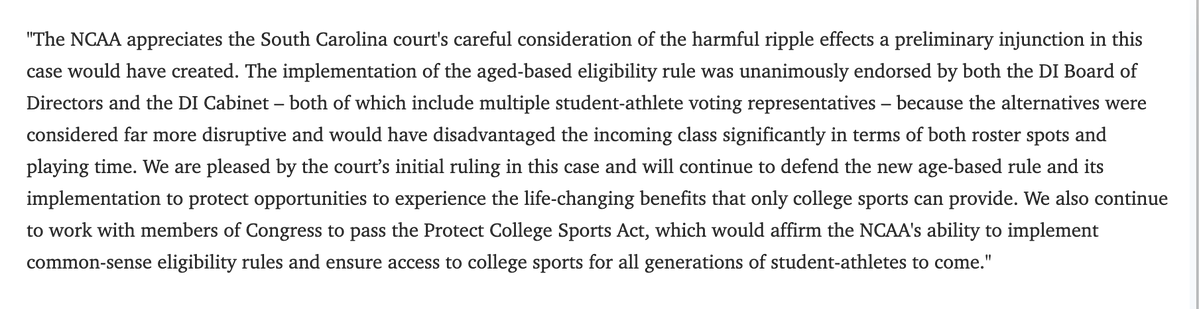
A judge denied college football players an injunction in a South Carolina eligibility case. Judges in Colorado, Nevada and New York have denied similar requests, while different athletes have won several other cases. It is creating inconsistencies. NCAA statement:
That split is the real story here. This isn't a settled legal question working its way toward one answer — it's dozens of individual courts reaching opposite conclusions on basically the same set of facts, which means a player's eligibility for 2026 increasingly depends on which state's courthouse they happened to file in. Beyond South Carolina, appellate courts in Ohio and Tennessee have already granted the NCAA's motion to stay similar preliminary injunctions, and a federal appeals court did the same in a separate case.
For McDoom, Hill and Verhoff specifically, the door isn't necessarily closed for good — a jurisdictional denial is different from losing on the actual legal argument, and their side could refile somewhere with a cleaner connection to the plaintiffs. But with the clock ticking toward the 2026 season and rosters already being built, every week these cases bounce around different state courts is a week these guys aren't practicing anywhere.
Expect more of these rulings to trickle in before the season actually kicks off, and expect them to keep contradicting each other. Until a federal court or the NCAA itself draws a single national line, this is going to stay a state-by-state coin flip for every class-of-2022 player still fighting for one more year.
More Stories
Florida QB vs. Georgia: Aaron Philo or Tramell Jones Jr.
Pat McAfee Utah College GameDay uncomfortable comments
Tommy Carr, Bryce Underwood: Michigan QB vs. Rutgers TBD
William Sanders injury: Alabama guard has TightRope surgery
Landen Hatchett season-ending injury Washington Huskies
Grant Beerman, Kai Pritchard out for season at Illinois