
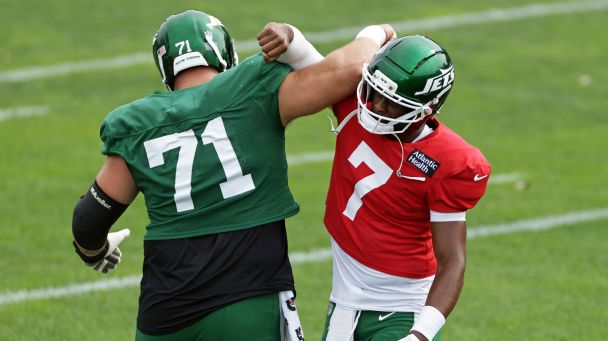
Jets camp is two and a half weeks old and the storylines are already writing themselves. Breece Hall has been the best player on the field on multiple days, ripping off long runs in pads on August 4 and getting praised as "phenomenal" by offensive coordinator Frank Reich a few days later. Geno Smith, meanwhile, was lights-out in June minicamp reps and looked sharp again in late July, only to go 2-for-7 in a two-minute drill against Tampa Bay on August 12, with drops and penalties muddying the picture. Camp stats lie constantly, but this is the kind of split-screen that fantasy drafters need to actually track instead of dismiss.
Start with the money, because it explains why Hall is even in this conversation as a locked-in RB1 candidate. New York signed him to a three-year deal worth up to $45.75 million back in May, with $29 million fully guaranteed over the first two seasons and a $14.5 million average annual value that ranks fourth among running backs, behind only Saquon Barkley, Christian McCaffrey and Derrick Henry. The Jets got that done before the running back market blew up further this summer, and Reich made a point of saying the team was relieved to have it finished. That's a front office telling you exactly how big a part of the plan Hall is.
On the field, the tape backs up the paycheck. Hall has flashed explosiveness in team drills alongside backup Braelon Allen, and even after a joint practice where he admitted Tampa Bay "beat us up a little," the concern was about the offensive line and overall execution, not his role. He's still the clear lead back in a backfield that doesn't have a real 1B threat behind him. The question for fantasy managers isn't whether Hall touches the ball enough, it's whether the touchdowns and receiving work come back after two seasons where both dipped. Third-round ADP feels like the market's compromise: too talented to fade completely, too many red flags to pay top-12 price.
Smith is the wild card that makes Hall's outlook murkier or better depending on how camp shakes out. He was 11-for-11 in 11-on-11 work and 4-for-4 in 7-on-7 drills on July 30, and Reich gushed about his "laser focus" and "pure" mechanics the following week. Then came the two-minute drill disaster against the Bucs, where drops from his receivers and a couple of penalties turned a clean rep into a mess. Add in the red contact lenses he's been wearing to cut down on glare, a trick he picked up from former teammate Santonio Holmes, and you've got a guy who is either fine-tuning a strong season or masking cracks that show up under pressure. Jets fans have seen this movie before.
The QB2 battle matters more than usual because of what it says about the depth chart's confidence level. Fourth-round rookie Cade Klubnik opened camp hot, going 6-of-7 in 11-on-11 work on July 30, but the interceptions came in a red zone period on August 1 and the whole thing has been up and down since, including a 10-of-14, 154-yard, 2-touchdown, 1-interception line on August 8. Journeyman Bailey Zappe is competing right alongside him and reportedly has the edge in command and experience. None of this changes Hall or Smith's fantasy value directly, but a shaky QB room behind Smith is one more reason the Jets can't afford instability at the top, which raises the stakes on every one of Geno's practice reps.
The name to know for waiver-wire purposes is Isaiah Williams. He came into camp viewed as a return specialist and fourth receiver at best, and he's instead been the standout wideout through two weeks, reportedly leapfrogging first-round pick Omar Cooper Jr. on the depth chart. If that holds into the preseason, Williams becomes a cheap late-round dart in best ball and a name worth stashing in dynasty, especially if Smith's accuracy issues are more about drops than arm talent. On the defensive side, second overall pick David Bailey has been a menace with three sacks in non-contact work on July 30, though an ankle injury from an August 8 scrimmage has him day-to-day and worth monitoring only for those in IDP formats.
Zoom out and the fantasy math is straightforward. Hall is a high-floor, capped-upside RB2 who needs touchdown regression to hit his current ADP, and his contract guarantees he'll get every opportunity to do it. Smith is a streaming-caliber fantasy QB whose weekly floor depends heavily on whether his skill players hold onto the ball, which makes his camp accuracy less predictive than the drop totals around him. Neither profile screams league-winner, but both are affordable enough that getting the range right, rather than nailing a exact projection, is the actual skill here. Keep an eye on preseason usage in the next two weeks. That's when Hall's workload split and the receiver pecking order behind Garrett Wilson start to firm up for real.