






MLB teams just blew past $400 million in draft bonuses
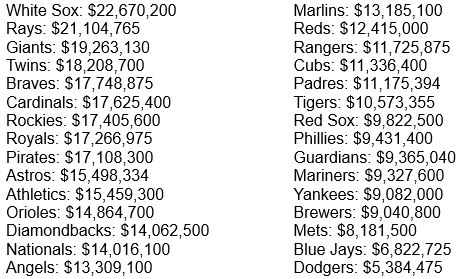


Every July there's a quiet arms race that happens away from the big league product, and this year it produced the biggest number the sport has ever seen. Teams combined to spend $402,481,143 signing drafted players in 2026, shattering last year's record of $392,533,711.
Teams combined to spend $402,481,143 on signing bonuses for drafted players in 2026, breaking the record of $392,533,711 set last year. Club-by-club spending:
The White Sox, picking No. 1 overall, set the pace for the whole industry. Chicago's top pick, shortstop Roch Cholowsky, signed for a reported $10.35 million, obliterating the previous draft-record bonus of $9.3 million shared by Chase Burns and Charlie Condon back in 2024. That windfall helped push the White Sox to a franchise-record $22,670,200 in total bonus spending, edging past the $21,150,840 the Orioles paid out just last year.
The @WhiteSox set a new team record for bonus spending at $22,670,200, surpassing the $21,150,840 the @Orioles paid last year. Nine of the 20 highest club bonus totals ever came in 2026:

It wasn't just the top of the draft inflating. The 25 first-rounders averaged a record $5,517,811 apiece, and 23 different clubs dipped into their allowed 5% pool overage this year -- tying the highest total since bonus pools started in 2012. Teams can go over their pool without losing future first-round picks, but they pay a 75% tax on the overage, and plenty of front offices decided it was worth it. The Giants, Rays and Tigers spent every last cent of their available overage.
The @SFGiants, @Raysbaseball & @Tigers were the only clubs to spend every penny of their 5 pct overage based on their original pool. The @CleGuardians did so after losing the pool money for not signing 2nd-rder Logan Schmidt. The @Astros came within $1, the @Dodgers within $20.
The Rays, as usual, were busy digging for value deep into the draft. Tampa Bay is set to sign third-rounder Gavin Giese, son of former big leaguer Dan Giese, for $997,500, and 11th-rounder Logan Georges for $597,500 -- a pair of prep righties who combined to cost the Rays nearly $1.6 million on deadline day. The Brewers and Pirates were doing their own bargain-hunting too, locking up projectable prep arms and a speedster outfielder well outside the marquee rounds.
11th-rder Logan Georges will sign w/@Raysbaseball for $597,500 ($447,500 counts vs bonus pool). California prep RHP, lively 92-96 mph fastball, flashes plus low-80s slider. @TCU_Baseball recruit. @MLBDraft

Not every team walked away clean, though. The Guardians were the lone club that failed to sign a top pick, watching second-rounder Logan Schmidt decline to sign. Cleveland forfeited that slot money entirely -- and, fittingly, still managed to spend its full pool overage anyway once the dust settled. It's a reminder that even in a record-spending year, the draft is still a game of leverage, and not every negotiation ends the way a front office wants.
Zoom out and the trajectory says everything about where the sport is headed. It took eight drafts after Gerrit Cole's $8 million bonus in 2011 for anyone to top it, and that didn't happen until Adley Rutschman went No. 1 overall in 2019. Now the top three picks alone are commanding some of the largest bonuses in draft history, and the industry as a whole just cleared $400 million for the first time. The pool system was designed to control spending -- instead, it's produced nine of the 20 largest single-team bonus totals ever in 2026 alone.
More Stories
Jackson Chourio 4 hits, Brewers beat Rays 10-0 in Game 3
Aaron Ashby scoreless streak nears postseason record
Mariano Duncan hired as Mets major league coach
Jackson Chourio throws out Liam Hicks at home in Game 2
Liam Hicks home run Rays vs. Brewers World Series Game 2
Christian Yelich RBI triple World Series Game 1 Brewers